Monday, April 8, 2013

Chicago Battle Bunker

This fantastic board was available only for painted armies.
This past weekend I was able to play in a three-round AdeptiCon primer tournament at the Games Workshop Battle Bunker in Chicago.  I've never played at a bunker store before, and I was excited to check out some of the armies and terrain.

Yes, that is a Warhound titan and nine(!) Contemptor Dreadnoughts.
I wasn't disappointed -- the store had a ton of awesome armies on display, and some of their terrain was inventive and impressive.

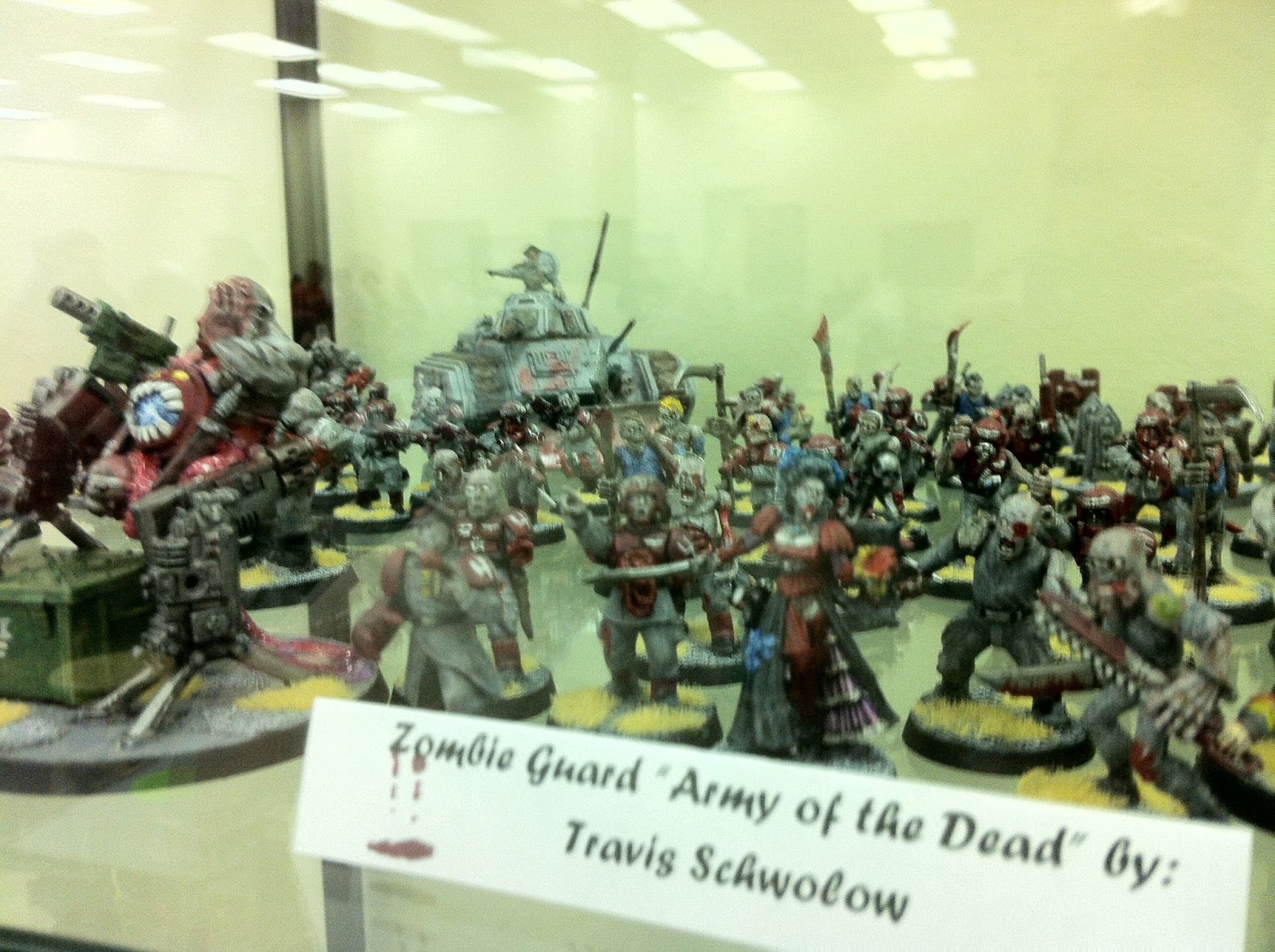
This highly converted zombie Imperial Guard army was very impressive.
The tournament itself was 1850pts using standard 6th edition rules -- the kicker being that the scenarios were from last year's AdeptiCon, which was run based on 5th edition.  Using the old deployment types and playing Kill Points every round was strange, but since this was a casual tournament I didn't mind.

Henry's army was beautifully painted, and his custom Aegis Defense Line got a lot of attention.
The first round was old-school Dawn of War: 24-inch deployment zones, one HQ and two Troops on the board, and everything else can walk on turn one.  The scenario called for Night Fighting turn one only and used six objectives, two of which had to be placed in your opponent's deployment zone.  The three victory conditions were Kill Points, control of more objectives in your deployment zone and control of more objectives in your opponent's deployment zone.

My opponent was Henry, and he was super cool to play against.  I'd bounced across the country with my army and had somehow managed to forget two of my Voidraven flight stands, my scatter dice, templates, and even my tape measure, and Henry was nice enough to let me borrow some of his extra gear through the length of the tournament.

I won the roll-off and deployed a couple of troops on objectives I'd placed at the 24" mark, forcing Henry's deployment into a six-inch window at his board edge (since the scenario required that you deploy 18" from enemy models).  You can see his deployment in the photo above; he put his Tervigon inside the Aegis Defense Line, the Hive Tyrant sort of behind the Aegis and in area terrain, and a squad of Termagants beside the Tyrant in area terrain and largely blocked from my line of sight.

My poor army needs some TLC.  I'm missing half my flight stands and most of my weapons have snapped off.
On the first turn I brought everything except for my three Voidraven Bombers onto the board.  That meant that Henry's three units were facing down five Venoms with Wracks in them and three Raiders loaded with Blaster-wielding Trueborn, a Haemonculus and an Archon with a Shadowfield and Huskblade.  Unfortunately for Henry, Night Vision completely negates the benefits of Night Fighting and I was able to take out his Tervigon before it had a chance to spawn.

Henry retaliated by bringing on his whole army - two more squads of Termagants, three Hive Guard, another Tervigon, a big squad of Gargoyles and a second flying Hive Tyrant - except for his two deep striking units.  He explained to me that, according to the rules as written (RAW), Tyranids can operate freestanding guns but not the ones that are built into fortifications (like the heavy bolters on a bastion).  I'm not sure if that's correct, but I was fine with it for this tournament.  Henry's Gargoyles snap fired the quad gun at me (since it's a heavy weapon and they moved onto the board that turn) and managed to wreck a Venom.  He advanced his two Flyrants, cast a couple of Psychic powers and that was about it.

This is going to hurt.
Turn two is where the game came to a head.  Two of my three Voidravens came on from reserve and the rest of my army shifted back to take advantage of the painful range disadvantage the Tyranids were sufferering -- with my Night Shields the quad gun couldn't even intercept the Voidravens.  Both Flyrants went down for the count before I finished firing my Blasters, and from there the game was just clean-up.  I took out the quad gun before my final Voidraven hit the board and unloaded as many large blast, strength 7 re-roll to wound missiles from my flyers as I could, and it wasn't long before Henry was out of Troops. His reserved models refused to join the fight until turn four, and by then the Doom and Trygon weren't nearly enough to deal with my remaining units.

Henry conceded and I took full points before turn five.

Defense lines make it easy to anticipate where your opponent will deploy.
The second round scenario used the old Spearhead deployment.  The three victory points came from Kill Points, controlling table quarters with scoring units, and holding a single center-of-the-board objective that could only be held by HQ units.

My opponent's name escapes me at the moment (sorry!) but he was another nice guy I was happy to play.  He was fielding squishy Imperial Guard with lots of heavy weapons teams, a couple of Leman Russ tanks and a single Vendetta Gunship.  I set up as close to him as I could get, with my Archon's Raider in the lead in case I could get an early charge off.

So many bodies!
He chose to break up his two platoons (which was a mistake, I think) and deployed everything except for his Vendetta.  The black tank in the upper left is a Chimera transporting Storm Troopers, the tank in the center is a Leman Russ Battle Tank and the one to the right is a Demolisher.


I tried to scatter to mitigate damage from the Leman Russ Battle Tank.

On my first turn I moved up and put enough fire into each of my targets to force morale checks, since he'd deployed them in separate small units close to his board edge.  He lost two squads over the edge of the world and four more were falling back at the end of the turn.  Most importantly to me I managed to kill off two bases each from a missile launcher heavy weapon team and a lascannon heavy weapon team, and force both to fall back.  My paper airplanes don't like being shot by either of those.

His first turn was rough, although he was able to rally both heavy weapons teams.  His shooting was largely ineffective, and all he managed was to Stun my Archon Raider.

The Voidravens look much better when I don't forget the flight stands.
Turn two saw all three of my Voidravens come into play.  I shot up his Chimera and wrecked it; shot up his Battle Tank and left it with a single Hull point; and nearly wiped the entirety of his infantry units.  I disembarked my Archon on the off chance I could pull off a 7-inch charge through terrain (I left the Haemonculus in the Raider so I wouldn't have to give up Fleet), but he failed to make it in.

On his turn two my opponent's Vendetta came on from reserve and tried to take down a Voidraven.  The reason the Voidraven is such a great dogfighter was evident here, as I shook off a penetrating hit with my Flickerfield and didn't have to sacrifice shooting to evade.  He did manage to take out my Archon's squad with the Demolisher and the Raider and Haemonculus with the Battle Tank as well, which meant that I'd have to board him to win full points.

On my third turn I shot down the Vendetta with a Voidraven and cleaned up nearly everything left on the board.  My opponent told me that he didn't see Dark Eldar often at the bunker, and he was shell-shocked when I picked off seven Kill Points in that turn.  He was left with nothing but a three-man squad of special weapons who ended their fall back move an inch from his board edge.

He rallied his last unit on his turn, so I walked some Wracks up to his quad gun and shot them down.  I won with full points by boarding him.

This was one of four Chaos-ed statues on the learn-to-play board.
I don't have any photos of my last game, unfortunately.  The scenario was a standard 12-inch deployment and victory points came from Kill Points, five standard objectives and slaying a single unit selected before the game begun.  My opponent was using the new Chaos Daemons codex, which I haven't had a chance to even look at yet.

His list included two squads of Daemonettes, two squads of Plaguebearers, a squad of Pink Horrors, a unit of 19 Flesh Hounds of Khorne, the Keeper of Secrets, the Lord of Change, and a Tzeentch Daemon Prince.  In addition to Psychic powers, the new codex apparently forces you to spend a half hour rolling to generate different attributes and abilities specific to Daemons.

This game wasn't a lot of fun, mostly because the codex seems to be pretty complex and I hadn't read it yet.  For example, my opponent rolled a power that he explained allowed him to reduce the invulnerable save of all of my vehicles to a 6+ for the duration of one phase.  Turns out that it doesn't work like that at all; the ability can only target units which contain a Daemon and is used primarily to boost a friendly unit's invulnerable save by two points, and it lasts for one turn.  I found that out the first turn when my opponent seized the initiative, and the Lord of Change cast Forewarning on the big unit of Flesh Hounds (who were suddenly an inch away with a 2++ save).

I spent my first couple of turns baiting his army into splitting -- big squads to my left where the objectives were, big models to the right and into the open -- so that I could mitigate the 38-wound 2++ unit of Flesh Hounds.  I didn't take much damage, since my opponent gave up Furious Charge in favor of charging multiple Venoms and whiffing, but the sheer number of models he had on the board ate up our time in just three turns.  By the time my reserves hit the board the game had swung into my favor, but with just three turns I wasn't able to pull out a victory.  I wiped the Flesh Hounds with Voidravens, reduced the Marked for Death unit to a single model and killed the Daemon Prince, but I'd lost more units than that when time was called.

Overall I had a great time and was happy that I'd had the chance to play.  I usually try to learn the broad strokes of every codex before playing in tournaments, and the last round against Chaos Daemons really reminded me of why I do that:  I don't mind taking the loss, but it would've been much more fun to finish the game -- even if the outcome had been the same.

Sunday, March 31, 2013

Covering the battlefield

There are a lot of logistics involved in organizing a grand tournament.  One major aspect of those responsibilities revolves around terrain -- it's important to have enough, to have pieces of quality people will be happy to pay to play on, and to appropriately control and categorize individual pieces so that they can be properly stored and transported.  I thought it might be interested to give you a glimpse at what's being done for the Golden Throne Grand Tournament 2013 in that arena.

Here's a snapshot showing terrain requirements for a 128-player tournament.

The unique tournament format for the Golden Throne allows for 128 players.  That's 64 tables, or over 1500 square feet of battlefields under one roof.  It's also a big crowd of players you don't want to disappoint with terrain that's lacking (or with a lack of terrain).  The old rule of thumb was 25% coverage, but that doesn't really jive with sixth edition missions -- instead the goal here is for a minimum of 30% coverage, or over 450 square feet of terrain (that's the estimated need, at least; the actual goal is 500).  The breakdown continues past that, displaying the estimated number of pieces of each type of terrain necessary to provide that coverage.  It's not just raw coverage that matters, though.

A great corner ruin, one of the cornerstones of tournament terrain.

The quality and diversity of terrain is as important as the amount of it.  No one wants to play on a table covered in Coke cans or old textbooks covered in felt -- what everyone wants is to be so deeply immersed in a game that, just for a moment, they can forget it's just a game and be drawn into it as if they were watching a great film.  The tournament format for the Golden Throne is built around that, emphasizing enjoyable, cinematic games rather than time-crunching turns and a race against the clock.

When I first saw this I thought, "What happened here?"
 Great terrain can tell a story.  I'm excited for the Golden Throne this year because that's the goal -- beautiful terrain, a relaxed tournament format, and great stories.

Saturday, February 16, 2013

Crash and burn

This is what the final straw looks like.

Fwoosh!

Some of the new flyer rules must be for flamers, because that's the sound of the new Death from the Skies supplement (which is available as of today exclusively through the Games Workshop website) burning bridges at several independent retail stores.

Here's an open letter from Pat Fuge, CEO of the Gnome Games retail chain in Wisconsin:

"Dear Games Workshop. You have made it less than desirable to sell your games and allow our place space to be used for your exclusive sales to the customers we take care of. For that reason all content in your new Aerial Combat Book is banned for all of our events. The book will not be allowed in our stores and is considered contraband.

GW players if you want to trade in your armies for store credit for Warmachine we have an opportunity for you. Please email ihategw@gnomegames.com for details."

Gary Ray of Black Diamond Games posted a similar sentiment on his blog:

"Trade in your current edition Warhammer 40K or Warhammer Fantasy rulebook and you take 40% off a starter box or rulebook for Warmachine or Hordes. We've done this with role-playing before, notably D&D and Pathfinder, so we know there are likely a bunch of rulebooks gathering dust and the need for excuses to start a new game. Let this be your excuse."

Additionally, as of this posting several other independent retailers have pledged to ban the use of Death from the Skies in their stores.  The supplement represents a tipping point in the strained relationship between independent retailers and Games Workshop, which released several exclusive products through their official website recently, cutting out independent retailers and driving consumers directly to Games Workshop for their hobby fix.  

Friday, February 15, 2013

More than just a Heldrake

No, really, it's good!
It seems like everywhere I look Chaos Space Marines are being trashed.  Either they're not competitive or they're not exciting, right?

Wrong.

The Chaos Space Marine codex is one the most well-written sets of rules in Warhammer 40,000.  More than that, I think the codex is dynamic, challenging and fun -- aside from Grey Knights, Chaos Space Marines are the only marine army that doesn't restrict your troops choices solely to marines.  The designers made a clear effort both to reinvigorate outdated codex choices and to introduce new and flavorful alternatives that work both thematically and competitively.

Close combat Dreadnoughts are few and far between in the competitive game.  They're slow, and it's not unreasonable for a lucky lascannon shot to blow them up.  Rather than do something silly like create virtually indestructible long-range, high-strength shooting attacks for them (like the aforementioned Grey Knights), the Chaos Space Marine codex offers you two new options for close combat Dreads: Helbrutes and Maulerfiends.  Both are inexpensive and both are better than a standard Space Marine Dreadnought, but it's the Maulerfiend that really stands out: he moves 12 inches without being slowed by terrain, is immune to dangerous terrain checks (thanks to Move Through Cover), has a 5+ invulnerable save, ignores Shaken and Stunned effects on a 2+, can reroll as many charge dice as he chooses, and is one of the most efficient close combat anti-vehicle models in the game.  All of that for 125pts is a steal.

At this point the Heldrake is fairly self-explanatory: the combination of strength 7, AP3 vector strikes (which ignore cover) and a strength 6, AP3 Baleflamer (which also ignores cover, has a 360 degree arc of fire and can be thrown 12 inches from the Heldrake itself) makes this bad boy a top contender for best Fast Attack choice in the game.  The Heldrake never has to Evade because it has a 5+ invulnerable save, and it's rarely affected by Shaken or Stunned results due to its 2+ roll to ignore them.  This thing lives to eat marines, particularly those of the Ravenwing variety.

The finished product.
Here's one of the first lists I built for this codex after it was released:

  • Typhus
  • 2 Helbrutes, double power fists
  • 35 Plague Zombies
  • 35 Plague Zombies
  • 30 Plague Zombies
  • 3 Maulerfiends
  • 3 Heldrakes, Baleflamers
  • Aegis Defense Line, Quad Gun
  • Total Points: 1845

The concept behind this list is to park a big group of Plague Zombies behind the Aegis Defense Line and let Typhus man the Quad Gun.  The Maulerfiends are usually able to get a second turn charge (at worst -- it's not uncommon to make the charge on turn one), and the Helbrutes follow a turn or two behind.  The combination of AV12 saturation, the Maulerfiends' speed and the survivability their invulnerable save offers them tends to overwhelm any opponent whose army isn't built around thunder hammers and storm shields.  Two or three Heldrakes usually join the party by turn two, effectively pinning the opponent down in his deployment zone -- his choices are to fight what's in front of him to avoid being boarded, or to shoot at literally 100 troop models that have a 4+ save with Feel No Pain and are Fearless to the last man.  I'll start moving those Zombies up to the midfield around turn three, and by turn five there won't be enough of my opponent's army left to contest.

It's a fun, fast-moving and hard-hitting army, and it's the off-the-top-of-my-head build.  What do you think -- am I wrong?  Is the Chaos Space Marine codex boring or bad?

Tuesday, February 12, 2013

The Spartan Steamroller

I snagged this Spartan photo from White Dwarf Daily.
I'm not super familiar with Forgeworld stuff, partially because I'm a relative newcomer to the game (I started playing the week the Dark Eldar codex released).  The wide push to integrate Forgeworld into grand tournaments this year motivated me to do some research into what's available, if only to help me learn what to expect from my opponents.  I haven't found much that merits inclusion in competitive armies, but a few gems stand out so far:
  • Hyperios Platforms cost the same as most devastators, and are better in almost every way.  In a standard marine army 140pts will buy you 4 platforms with a better chance to hit ground targets and flying targets than typical marines, with the additional benefit of toughness 6 and two wounds.
  • Predator Executioners seem to be pretty fantastic.  They're essentially a three-shot plasma cannon that doesn't get hot.  I'm not certain that they deserve sponsons, since they're not fast even in a Blood Angels army, but a couple of these should be able to hammer infantry units or bundled tanks pretty savagely.
  • The Spartan Assault Tank is incredibly good.  For 55pts more than a standard Land Raider you get two more twin-linked lascannons, an extra hull point and a 25 model capacity.  
I've always wanted to paint a Blood Angels army, and I figured this was a good chance to build something fun and competitive.  Here's the list I came up with:

This isn't my model, but I wish it was.
  • Librarian with Shield of Sanguinus, Unleash Rage
  • 24 Death Company, 5 power mauls
  • 5 Assault Marines, Razorback with twin-linked assault cannon
  • 5 Assault Marines, Razorback with twin-linked assault cannon
  • 5 Assault Marines, Razorback with twin-linked assault cannon
  • 5 Assault Marines, Razorback with twin-linked assault cannon
  • 5 Assault Marines, Razorback with twin-linked assault cannon
  • Spartan Assault Tank, no-melta-for-you-upgrade
The total cost on this list is only 1745pts.  I had a chance to test it out tonight against James, a Chaos Daemon player with the following list:

This actually is James' Nurgle Daemon Prince, as featured on BoLS.
  • Epidemius
  • Great Unclean One
  • 7 Plaguebearers
  • 7 Plaguebearers
  • 9 Flamers of Tzeentch
  • 9 Flamers of Tzeentch
  • CSM Daemon Prince of Nurgle, Power Armor, Wings, Black Mace, Psyker Mastery 3, Spell Familiar
  • 15 Cultists, Mark of Nurgle
  • Aegis Defense Line, Quad Gun
We played a Bay Area Open scenario with Purge the Alien as the primary mission (4pts) and the Scouring as the secondary (3pts) in Vanguard Strike deployment.  I deployed in a brick right up against the line with the Librarian and Death Company in the Spartan, two Assault Marine squads in Razorbacks and three more Assault Marine squads in reserve.  James stuck his Daemon Prince in a ruin for a 2+ cover save (since Daemon of Nurgle gives him Shrouded) and put his Cultists on the defense line.  

I went first and didn't accomplish much aside from putting a couple of wounds on the Daemon prince and one on the autocannon.  James got his preferred wave and ran right into my anti-Daemon spread of Razorbacks, scattering a squad of Flamers and Epidemius into mishaps.  He repositioned his prince as a counter-charge unit against my impending Death Company assault and it was my turn again.

Turn two I managed to immobilize my Spartan, but only after moving five of the six inches I was planning to.  I disembarked my twenty-five Angels, repositioned my Razorbacks, and proceeded to wipe James' poor Daemon Prince with the Spartan's quad lascannons.  The Death Company handled the Cultists with ease and officially cleared the opposing backfield for me, and at that point the game was pretty much finished.  James' Flamers couldn't get a great bead on my Death Company because I shielded them with Razorbacks, and even if he could've their Feel No Pain and the huge number of models I had on the board would've made for an uphill battle.  We called the game after he lost a squad of Flamers to a round of shooting and the other rolled a mishap and I placed them in the far corner of nowhere.

Overall I'm incredibly happy with the Spartan.  For 55pts more than I would've paid for a Land Raider I was able to transport a 25-man bomb unit across the board and throw four twin-linked lascannons at the Daemon Prince each turn.  The increased number of lascannon shots was a big deal, since moving the Land Raider 12 inches on turn one meant that I had to snap fire -- the two extra shots meant four more chances to roll a hit, and put a wound on that nasty Nurgle prince.  Sixth edition games tend to reward armies that can control the midfield and pressure the opponent's deployment zone, and the Spartan really delivers in that regard -- it's nearly impossible to destroy and delivers an absolutely beast close combat unit.  

Dr. Science and Sergeant Smarty Pants

One of my three Forgeworld Void Dragon Phoenix models, used as Voidraven Bombers.  This is a work in progress shot.
“Dark Eldar and Eldar?  I don’t get it,” said Dr. Science.

“Yeah, Eldar are meh and Dark Eldar are even more meh.  Together they’re terrible,” responded Sergeant Smarty Pants.
This exchange happened a foot away from me at the recent Emerald City Slaughter Grand Tournament in Seattle.  These two players seemed puzzled as to how in the world my army had landed on table three during the final round of the two-day tournament, and the weird thing for me is that this wasn’t a new development: people often seem surprised when Dark Eldar do well in tournament play.
In reality, though, the Dark Eldar/Eldar combination is one of the most vicious ally choices in the game today.  I finished the GT as Master Tactician, their title for best general, with only a single loss and the second highest battle score in the tournament (behind Best Overall).  Here’s the list that I ran (or the close approximation):
-Haemonculus, Liquifier
-3 Squads of 4 Trueborn with Blasters in Raiders, Night Shields
-5 squads of 3 Wracks in Venoms, Night Shields
-3 Voidraven Bombers, Night Shields, Flickerfields
-1 Farseer on Jetbike
-5 Guardians on Jetbikes
It doesn’t look like much, right?  The key here is the fact that the metagame is shifting toward rewarding players for putting boots on the ground rather than using minimum-sized squads as a tax for buying transports.  Venoms are the game’s most vicious answer to this trend, because they don’t care whether you’re playing marines or guardsmen or tyranids — toughness seven or three, Venoms don’t discriminate.  The more the metagame shifts toward infantry-heavy lists, the more decisive the power of the Venom becomes.  Are you thinking that your marines are no guardsmen and can stand up to my AP5 Venoms?  Sorry to break it to you, buddy, but your marines cost three times as much as those guardsmen and take exactly three wounds to kill, as opposed to the one it would’ve taken to down the guardsmen.  From my end there’s absolutely no difference between the squishy bodies at the other end of my barrel.
The most common criticism of Venoms I hear is that they’re AV10 with two hull points, which I guess makes people think they’re not worth playing.  Here’s the thing, though: that only matters if they’re getting shot at.  Being a fast skimmer means that they can move 12″ and still fire 12 shots at full ballistic skill; add to that the 36″ range of splinter cannons and they’re effective at up to 48″ away.  Assuming I’m looking at a squad of Long Fangs, that means that I have a six-inch bubble of impunity granted by my Night Shields where I can shoot but can’t be shot.  Once you’ve considered that, add night fighting to the mix and you’ll have a better idea about how survivable Venoms actually are.
The Voidravens are massively overcosted at 205pts each, but the remainder of my army is so points efficient that I can afford them.  They’re fantastic dogfighters since they don’t ever have to evade (go go Flickerfield!), and their missiles (large blast, strength seven, reroll to wound) really put the hammer on large squads of infantry.  The Voidravens can splinter even full squads of terminators, leaving little more than cleanup work for the Venoms.
The three squads of Trueborn in their Raiders do the majority of my tank-popping.  With the equivalent of fifteen Dark Lances altogether, I don’t often have trouble dealing with heavily armored lists.  Those that do resist the Dark Lances typically get acquainted with my Void Lances beginning on turn two.
The last little part of my army is my Eldar ally.  The Farseer carries Runes of Warding to protect me from irritating psykers, and he swaps out his two codex powers for Prescience and whatever else he rolls from Divination.  Twin-linking Dark Eldar firepower can get ridiculous, whether it’s blasters firing at flyers, Venoms firing at troops or large blasts that can reroll their scatter dice, twin-linking is something the Dark Eldar codex lacks and which makes their firepower absolutely overwhelming.  Additionally, the speed of Eldar jetbikes typically means that I don’t have to worry about scoring Linebreaker and often allows me to harass gunlines that lack effective counter-charge units, like Imperial Guard and Tau.
My list isn’t fantastically easy to play well, and it’s not the only Dark Eldar/Eldar list that can do well in competitive environments.  That’s kind of my point, though: since sixth edition hit I’ve seen competitive builds for almost every codex in the game.  We’re moving into a whole new era for Warhammer 40k, with the majority of the game still unexplored.  Those two guys who didn’t understand how I was doing well didn’t do very well themselves, and I think that’s probably because they write armies off as noncompetitive without bothering to actually look at lists and try to understand their focus.  With this new world out there, what are you going to win with?